Search This Blog

Showing posts sorted by relevance for query hiza guruma. Sort by date Show all posts

Hiza-guruma - Understanding The Judo Practice

Understanding Hiza Guruma(膝車)in Judo Practice

Hiza Guruma, often searched online as hiza garuma, is a classical Judo throw highlighting timing, posture, and refined movement rather than force.

This technique appears early in Judo education because it teaches essential throwing principles that apply across many Ashi-waza techniques. Although beginners practise it often, experienced judoka continue refining it throughout their training careers.

Image of Newport Judo Logo - This article is about Hiza-guruma. Understanding The Judo Practice
Stand Tall: Respect and Affect
Click Here For More Information

Classification and Technical Family

Hiza Guruma belongs to the foot and leg technique group known as Ashi-waza within the Kodokan classification system. According to the Kodokan, Ashi-waza throws rely on precise placement, balance disruption, and coordinated upper-body control.

You can explore the official classification through the Kodokan Judo Institute at kodokanjudoinstitute.org > en/waza/list.

The name Hiza Guruma translates as “knee wheel,” which accurately describes the throwing action involved. Rather than sweeping the leg, the throw blocks the opponent’s knee and rotates them forward.

This rotational effect distinguishes Hiza Guruma from techniques like De Ashi Harai or Okuri Ashi Harai.

Grip and Initial Movement

Execution begins with a standard sleeve and lapel grip, although grip variations exist depending on stance and strategy. From this position, you encourage your opponent to step forward naturally, maintaining upright posture and relaxed movement.

As the opponent advances, you initiate kuzushi by pulling forward and slightly upward with coordinated arm action. Grip tension should remain firm yet responsive, allowing adjustment as the opponent’s balance changes.

Active posture ensures your hips, shoulders, and feet remain aligned throughout the entry. This alignment prepares the body for effective rotation rather than pushing strength.

Kuzushi and Balance Direction

Balance breaking remains central to effective Hiza Guruma and must occur before any attempt to block the knee. Specifically, you direct the opponent’s balance toward the front corner on the sleeve side. The knee being blocked is critical to making the throw work. From observation (see the video below) alone, it is often thought that Tori's foot is placed on the side of the leg, avoiding the knee altogether. This can work if there is enough momentum whilst spinning, tornado-like (Garuma - wheeling), your Uke around. However, execution will always be poor, or even non-existent, if Tori tries to use the foot placement as sweeping the leg. It must be a block.

This direction aligns their weight onto the stepping leg, creating the ideal moment for the block. Without proper kuzushi, the knee block becomes ineffective and easy to step around.

Therefore, experienced judoka prioritise off-balancing before foot placement. This sequence reflects fundamental Judo principles taught across throwing techniques.

Wait... More Martial Arts Judo Information Loading


Knee Block and Upper-Body Rotation

At the precise instant their weight settles, you place the sole of your foot against the opponent’s knee. The foot contacts just above the kneecap, acting as a firm post rather than a striking motion.

Importantly, the blocking foot remains stable and controlled throughout the throw. Next, you rotate your upper body smoothly while continuing the pulling action with both hands.

Your torso leads the movement, ensuring the opponent turns over the blocked knee in a circular path. Because the knee cannot continue forward, the opponent’s body rotates and collapses naturally.

Timing and Sensitivity

Timing separates effective Hiza Guruma from failed attempts. If the block arrives too early, the opponent adjusts their step and regains balance.

If the block arrives too late, the opponent’s weight has already passed the knee. Therefore, skilled judoka focus on rhythm, observation, and sensitivity rather than speed alone.

This emphasis aligns with Jigoro Kano’s principles of maximum efficiency and mutual welfare. Further background on these principles appears at the International Judo Federation website, ijf.org - history.

Tactical Use and Combinations

Hiza Guruma pairs well with other forward-moving techniques sharing similar balance directions. For example, judoka often combine it with Sasae Tsurikomi Ashi or Tai Otoshi.

These combinations exploit repeated forward steps and opponent reactions. Defensively, Hiza Guruma works best against opponents who step assertively or push forward aggressively.

Rather than resisting force, the throw redirects momentum into controlled rotation. This quality makes it especially effective against taller or physically stronger opponents.

Teaching Value and Skill Development

From a teaching perspective, Hiza Guruma reinforces posture, grip discipline, and coordinated movement. Coaches frequently use it to correct excessive sweeping motions or poor kuzushi habits.

As a result, the technique serves both technical and educational purposes within Judo training. Hiza Guruma demonstrates how small, well-timed actions produce decisive outcomes on the mat.

Its reliance on balance, rotation, and precision reflects the deeper logic behind effective Judo throwing.


You may also find these articles helpful:

Judo Hiza Guruma (Knee Wheel) Throw: Mechanics and History

Hiza Guruma: Unveiling the Mechanics and History of the Knee Wheel Throw in Judo

Judo, the Japanese martial art known for its throws and grappling techniques, boasts a rich tapestry of moves that have intrigued practitioners and enthusiasts for generations. One such technique is Hiza Guruma, the knee wheel throw, renowned for its intricate mechanics and historical relevance. In this article, we delve into the details of Hiza Guruma, exploring its fundamental mechanics, historical roots, and tactical adaptations.

Image of Newport Judo Logo - This article is about Judo Hiza Guruma (Knee Wheel) Throw
Stand Tall: Respect and Affect
Click Here For More Information

I have discussed this throw before but I particulaly like the circular motion discribed here. When getting students to train for this I often turn it into a bit of a game. Getting the student to start nominating Tori and then get both players to spin around. when both students have are ready Tori raises the trowing leg and complets the throw. This is a lot of fun but you do have to monitor that judoka don't get over enthusiastic and spin too fast to be safe.

The Mechanics of Hiza Guruma

At its core, Hiza Guruma is a foot technique that involves unbalancing an opponent and strategically utilizing the knees to execute a throw. The throw initiates with a gripping exchange, often from a traditional right-handed grip. The practitioner then creates a dynamic circular motion, drawing their opponent slightly to the outside of their foot. This off-balancing, known as "kazushi," sets the stage for the throw.

The key to a successful Hiza Guruma lies in the precise execution of the circular movement. As the thrower swings their hips around, the opponent's weight is shifted forward, causing them to stumble. This delicate maneuver positions the opponent's knee at a vulnerable angle. To prevent the opponent from countering or collapsing, the thrower may strategically block the knee or use their body weight to lock it, rendering it temporarily immobile.

Historical Significance

Hiza Guruma's historical significance is intertwined with the martial arts lineage of its originators. Jigoro Kano, the founder of Judo, developed the technique after being inspired by his close friend, Takamatsu Sensei, a master of traditional jiu-jitsu. Kano Sensei incorporated Takamatsu Sensei's favorite technique into Judo's curriculum, preserving its essence and passing it down through generations.

Wait... More Martial Arts Judo Information Loading


Tactical Variations

Hiza Guruma offers practitioners a versatile canvas for tactical adaptations. One such variation involves countering an opponent's Hiza Guruma attempt by disrupting their circular motion or neutralizing their balance. By walking into the circular path of the throw, an adept defender can effectively cut off the technique's momentum, preventing a successful execution.

Additionally, the technique can be modified for a more competitive context. Practitioners can exploit openings created by their opponent's Hiza Guruma attempt to transition into other throws or takedowns. For instance, countering an opponent's knee wheel with a swift o-soto-gari can catch them off guard and lead to a successful takedown.

Conclusion

Hiza Guruma, the knee wheel throw in Judo, exemplifies the intricate fusion of technique, history, and adaptability that characterizes martial arts. Its mechanics, grounded in precise circular motion and strategic knee manipulation, create a captivating spectacle of balance and skill. As practitioners delve into the art of Hiza Guruma, they connect with a lineage that stretches back through time, honoring the legacy of its originators while embracing the evolution of tactical variations.


Judo Hiza Guruma (Knee Wheel) Throw

Judo Hiza Guruma (Knee Wheel) Throw

A Comprehensive Guide to the Hiza Guruma Throw

In the world of Judo, mastering a technique requires more than just physical strength; it demands precision, balance, and finesse. One such technique that has captivated practitioners for generations is the "Hiza Guruma" throw, commonly known as the "Knee Wheel" throw. In this article, we explore an instructional video featuring Steve Cunningham as the instructor (tori) and Fred Spaeth as the demonstrator (uke), offering valuable insights into the subtleties of this dynamic Judo move.

Image of Newport Judo Logo - This article is about Judo Hiza Guruma (Knee Wheel) Throw
Stand Tall: Respect and Affect
Click Here For More Information

The Hiza Guruma, or Knee Wheel throw, is a captivating technique that exemplifies the grace and power of Judo. This article delves into an instructional video that aims to elucidate the finer points of executing this technique, offering practitioners a valuable resource to refine their skills.

Instructor and Demonstrator

Steve Cunningham, an accomplished Judo practitioner, takes on the role of instructor in the video. As the tori (the person executing the Judo technique), Steve's expertise shines through as he breaks down the mechanics of the Hiza Guruma throw. On the other side of the equation is Fred Spaeth, who plays a pivotal role as the uke (the receiver of the technique). Fred's willingness to participate in the demonstration allows viewers to witness the technique's practical application.

Focus on Technique Demonstration

The instructional video's primary objective is to provide a step-by-step demonstration of the Hiza Guruma throw. It invites viewers to follow along closely, emphasizing key elements necessary for the successful execution of this Judo move.

Wait... More Martial Arts Judo Information Loading


Breaking Down the Technique

Hiza Guruma, a combination of "Hiza" (Knee) and "Guruma" (Wheel), resembles a whirling motion, much like a wheel or, interestingly, a car in the Japanese language. The essence of this technique lies in the artful execution of pulling the opponent's knee slightly to the right front corner and, through a well-timed maneuver, causing them to trip over a low obstacle.

Hiza Guruma is categorized as an Ashiwaza, a foot technique. This throw's intriguing history reveals its significance in Judo's evolution, as it was a favourite of Jiu-Jitsu master Takamatsu Sensei, a close friend of Judo's founder, Jigoro Kano. Kano was so impressed by the technique that he incorporated it into the Judo syllabus.

The heart of the Hiza Guruma throw lies in generating a significant amount of power to unbalance the opponent. This is achieved through a well-timed hip swing, creating a circular motion to draw the uke off-balance and overextended. A simple lateral step won't suffice; practitioners must move in a circular motion to ensure the desired effect.

Initiates The Technique

The tori initiates the technique from a normal grip with the uke's right foot slightly behind. To pull off Hiza Guruma successfully, the tori begins by pulling off the end of the uke's shoulder, swinging the hips around to draw them forward, thus utilizing their body weight as a counterweight. This movement is pivotal in drawing the uke out and off-balance.

One critical aspect is to stop the uke's knee from bending as it can spoil the technique. Two methods are employed to prevent this - the tori can either push underneath the knee or lock the knee by applying pressure. This knee control only needs to be maintained for a brief moment to ensure the throw's success.

Crucial to this technique is the positioning of the standing foot. It should point at the foot that will be attacked, enabling the tori to complete the throw to the front. Turning the standing foot is essential, as it facilitates a broad, sweeping hip motion that creates the necessary off-balance (Kazushi) for the technique.

Showcases The Beauty And Effectiveness of Hiza Guruma


O-Soto-Guruma, Hiza Guruma Etc. Why The Word is in All The All The Guruma Throws

O-Soto-Guruma, Hiza Guruma Etc. Why The Word is in All The All The Guruma Throws

In the first few moments of the Hiza Guruma video below there is a description of the word Guruma. As I was always taught by my sensei he says that the word Guruma means wheel. He also says in passing that it also means motor car. This turns out to be an incomplete explanation. The kanji in the throw name is 車. I have heard it suggested that this is because a car has a steering wheel. Thus distinguishing it from a cart or carriage. Which have different Japanese names. Added to this, I was taught that "car" was pronounced "Kuruma", not Guruma. One explanation of this is the word Kuruma has been anglicised to Guruma. The problem is that all of these definitions are very simplistic. It can mean wheel but it can also mean turning as well as a bunch of other things. All of which may be of interest to Japanese language students but what does it have to do with O-Soto-Guruma.

Image of Newport Judo Logo - This article is about O-Soto-Guruma, Hiza Guruma Etc. Why The Word is in All The All The Guruma Throws
Stand Tall: Respect and Affect
Click Here For More Information

The use of the word Guruma as wheel, in o-Soto-Guruma has always been confusing to me. Because there seemed to me to be no wheeling action in the throw. It was more of a driving action. Different instructors have tried to demonstrate the wheel action in the throw but I could never see it. For the most part, that was also the case for most of the Guruma Judo throws. It didn't help when I learned that Guruma was related to Kuruma (car). Thus the driving action made sense. Unfortunately, historically, that is not what is intended.

It took me a long time to learn that the wheeling action is not over the leg at all, as I thought and taught. There is in fact a twisting action, similar to  Uki-Goshi in the throw. It is this twisting action that is defined by the word Guruma. This is where the videos come in. If you watch closely you can see the turning action to complete the throw. Both O-Soto-Guruma and Hiza Guruma are good examples of this when taught properly.

Wait... More Martial Arts Judo Information Loading


It is more than just seeing that there is a wheel in the throw after all. The throw is executed much more effectively when there is a twisting action in the throw. Where Tori rotates their hips and does not push with their arms to complete the throw. In the same way, the arms in O-Soto-Guruma are not doing the bulk of the pulling. Rather they are holding Uke in place as Tori rotates. Also, the leg is not sweeping. Though there may be some sweep due to momentum. But primarily the leg is stopping Uke from going where Tori does not want them to go.

If O-Soto-Gari is a throw of your choice, you would be well served to pay attention to these two videos below.


Hiza Guruma Judo Throw: The Correct Foot Placement

How To Do Hiza Guruma Judo Throw With The Correct Foot Placement

It is very common for the placement of the foot and in particular the heal, to be incorrect when doing the Judo throw Hiza-Guruma.

Image of Newport Judo Logo - This article is about How To Do Hiza Guruma Judo Throw With The Correct Foot Placement
Stand Tall: Respect and Affect
Click Here For More Information

This is possibly not surprising because I was never corrected when I was a junior. That is not necessarily the fault of the instructor as it can easily appear that the foot position is correct or assumed that it is correct because the throw appears to execute O in practice as Uke cooperates and falls over.

As a junior Hiza-Guruma rarely worked

As a junior when I started competing and found that Hiza-Guruma rarely worked. I concluded that the throw was basically a show throw and not very useful. However, when I observed that others were getting it to work I realised that something was wrong so I started to research why. The problem was that, just as my instructors had assumed I was doing the throw correctly, it appeared to me that everybody was doing it correctly as well.

It turned out that there were and still are a lot of Judoka that do it incorrectly.

Wait... More Martial Arts Judo Information Loading


The flawed assumption

One flawed assumption is that the throw is executed by blocking the leg. The blocking is correct but for Hiza-Gurma to work you have to block the knee not the thigh or the shin as many do. This is a problem because it allows Uki to just step over the foot and avoid the throw altogether.

The other flawed assumption was that the throw is executed by your toes around the knee or leg in order to push the leg inward towards Uki's other leg causing uke to stumble forward as they try to continue in a straight line or roll sideways. This actually works sometimes but requires a lot more instability than is mostly the case even in a competition or in the case of rolling sideways for Uki to be doing something like skipping around Tori in a circle. The latter does sometimes happen which I suspect is why Judoka continue to do it this way.

Variation or Efficiency

Of course, if Uke does skip sideways and they are caught by Troi's foot around the knee, this is still Hiza-Guruma, it's just a variation. However, it is a movement that is way less common and the throw can work in many other instances if it is just done correctly.

The video shows the correct placement of the foot/heel in order to make the throw work most efficiently. I wanted to concentrate on foot placement because that is the most common error. So the Kuzushi (breaking of the balance) is not included.

Dah! or Ahh!

Now I know there are some reading this that are going to say, "well Dah!" But keep in mind there are a lot of Judoka that have had problems with this throw without knowing why. They are not one of the lucky ones that intuitively got it right. They are not one of the even rearer Judoka that had it taught to them the correct way from the very start.

I am willing to bet that there will be a lot more people that watch this video and rather than saying, "Dah" they will say, "Ahh! that's how it is supposed to work".


Hiza-Guruma - A Judo Throw For Wheeling Knees

Hiza-Guruma - A Judo Throw For Wheeling Knees

Sometimes the name of a throw is the real key to learning how to do a throw. Hiza-Guruma is one of those throws. Popularly translated as "knee wheel" it is just what it says. I wish someone had told me that when I did it wrong for all those years.

Image of Newport Judo Logo - This article is about the Judo Throw Hiza-Guruma
Stand Tall: Respect and Affect
Click Here For More Information

When I first learned this throw, despite the best efforts of my coach, I was convinced that the correct way to do it was to place your foot behind the knee and effectively collapse the knee to cause Uke to stumble. Thus causing them to fall. All you had to do then was to take them to the ground.

What surprises me is that almost all my new students have to have that same action taught out of them. I have no idea what it is but it seems to be something in our bodies that makes us feel the need to put the foot behind the knee instead of directly in front of it.

You can see clearly from the video attached that Tori's foot is placed in front of the knee effectively stopping further movement rather than causing Uke to stumble. Thus this is much more a knee block than a trip.

Wait... More Martial Arts Judo Information Loading


Let's follow the steps:
Uke's knee can either be lagging or advancing. Both are Hiza-Guruma and both work equally as well. But for this example, let's stick to the lagging knee that is in the process of advancing, as in the video.

  1. You must make sure you are out of the way of Uke's forward movement
  2. Remember the wheel part of the name? you have to wheel your way out of the way. There are a variety of ways to do this but the important thing is that you cannot be directly in front of Uke. If you are:
    1. You will be forced to bend your knee and not be able to properly place your foot
    2. You will interfere with the forward motion of Uke, hindering their fall


  3. Tori draws Uke forward, causing them to try to take a step forward with their lagging leg in order to maintain balance
  4. This is critical as without this drawing there is no Kuzusi (breaking of the balance).

  5. Tori raises their leg and us firmly placing their foot directly above the knee
  6. The foot has to be directly on top of the knee cap (or as close as possible) because any lower would potentially allow Uke to step over and any higher means you would be placing your foot on the upper leg with all its power potentially forcing it's way forward to regain balance.

  7. Tori turns their head to look in the direction of the throw
  8. Without the turning of your head the upper body works against the lower body reducing the power of the pull through. You should always look where you are going not where you are coming from.

  9. As Tori's head turns the pull that you started the kuzusi with is continued without change of direction and without reduction in force
  10. There is a temptation to pull down as you are trying to complete the throw. This is a mistake and totally unnecessary. If you pull down the momentum is reduces and you take the risk of pulling Uke onto their own feet thus defeating the throw. Besides pulling down means you cannot wheel around.

There are all sorts of variations to this Hiza-Guruma but they are primarily different in their entry only. The core remains more or less the same as the above.

The biggest danger you face when doing this throw in Sheai (competition), is being too enthusiastic in placing your foot and kicking Uke, resulting in disqualification. Only quality practice can avoid this.

This in principle is a simple throw to teach but in practice, getting people to stay out the way of Uke's forward movement can be a challenge for beginners. This too only quality practice will solve.


Judo Renzoku Kaeshi Gokyo for Progressive Training

Exploring Judo Renzoku Kaeshi Gokyo for Progressive Training

Judo has always emphasised the balance between attack, counterattack, and continuous movement. When studying the Gokyo no Waza, students often focus on isolated throws. Yet, there is immense value in seeing these throws as connected movements rather than as stand-alone techniques.

Image of Newport Judo Logo - This article is about Judo Renzoku Kaeshi Gokyo
Stand Tall: Respect and Affect
For More Information

OR
Book A Class

The Core Concept

This approach, which integrates Judo Renzoku Kaeshi Gokyo, explores how throws can function as both combinations and counters. Students gain a deeper sense of timing, reaction, and adaptability by progressing through the five kyō with this lens.

Using A Throw Against Itself

It is widely recognised in Judo that many throws can be used against themselves.

For example, De-ashi-barai (often called De-ashi-hari) may be applied as a direct counter to an opponent’s De-ashi-barai. Likewise, O-soto-gari can be countered with another O-soto-gari, provided the defender times their entry correctly. This principle highlights the reactive nature of Judo and reveals mirror-like counters in live practice.

Wait... More Martial Arts Judo Information Loading


Why Linking Throws Strengthens Learning

Traditional study of the Gokyo often separates each throw for technical mastery. However, judoka quickly discover that many techniques flow into one another naturally.

For example, De-ashi-barai sets the stage for Hiza-guruma; if the first attack fails, the second may succeed. Likewise, O-soto-gari can transition seamlessly into O-goshi depending on the opponent’s resistance. By explicitly teaching these links, students sharpen their awareness and perceive shifting opportunities in live practice. This technique does not work for every throw in every kyo, but it does for most. Students and coaches should be willing to experiment.

The Dual Role: Combination And Counter

The concept becomes more powerful when students recognise that the next throw can act as either a renzoku-waza or a kaeshi-waza.

Consider Hiza-guruma applied after De-ashi-barai; this may appear as a continuation if the opponent resists forward. However, if the opponent attacks first with De-ashi-barai, Hiza-guruma also serves as a counter. This dual nature builds flexibility and helps practitioners anticipate both attack and defence within one framework.

A Progressive Multi-Week Approach

To put the method into practice, a structured plan proves invaluable for instructors and students alike.

Training each kyō in progressive blocks allows the coach to highlight specific throw pairs and teaching points. Constraints during randori reinforce application under pressure and accelerate learning of practical transitions. The sequence begins with the first kyō, broken into smaller clusters, and gradually moves toward sutemi-waza.

Sample chart demonstrating the concept

Starting Throw Follow-Up Throw Function Training Focus
De-ashi-barai Hiza-guruma Combination / Counter Early foot sweeps, timing of reactions
Hiza-guruma Sasae-tsurikomi-ashi Combination / Counter Balance breaking with leg redirection
O-soto-gari O-goshi Combination / Counter Transition from leg to hip engagement
Tomoe-nage Kata-guruma Combination / Counter Sacrifice throw into the shoulder wheel
Harai-goshi Uchi-mata Combination / Counter Switching between major hip techniques

Benefits of the method

Adopting a Judo RenzokuKaeshi Gokyo approach gives several clear benefits.

  • Enhanced adaptability: Students anticipate resistance and redirect energy effectively.
  • Deeper understanding: Throws are studied in context, not in isolation.
  • Improved randori skills: Constraints encourage experimentation with live counters and combinations.
  • Progressive structure: Students see their skills grow through each kyō systematically.

Applying the method in dojo practice

Instructors may adapt the structure to their dojo environment and term length.

A six-block or ten-block curriculum can be chosen depending on available weeks and student skill levels.

Adding randori rules, such as “only use sacrifice throws this round,” helps reinforce lessons under pressure.

Students gain confidence when drills evolve into live practice with controlled limits and clear goals.

References and further reading

For additional insights on Judo training methods, consider resources from reputable sources like the Kodokan.

See the Kodokan Judo Institute for historical material and modern applications: Kodokan Judo Institute.


Hiza - Guruma: The Knee Wheel Where everybody Ignores The Knee

Hiza - Guruma: A Knee Wheel, Not Behind The Knee Wheel

When I first learned Hiza - Guruma as a junior I was convinced that the object was to place my foot on the side of the knee and turn my toes into the back of the knee to try and force it to bend. In this way, I believed, the idea was that my opponent would lose their balance and I would take them down with my hands and arms. It is Supprising to me now that this actually worked for me, quite often.

Image of Newport Judo Logo - This article is about Hiza - Guruma
Stand Tall: Respect and Affect
Click Here For More Information

Clearly, nobody noticed but I was doing it wrong and I was not shown any different ways to do Hiza - Guruma until I was a senior. What is even more surprising is the number of students that I still get from other clubs, that I have to teach this out of. The above is clearly a common misconception. The reality is that the side of the knee is not where you should place your foot.

I suppose I should not say it was wrong, after all, it actually worked much of the time and that is probably why so many others have the same misconception. So the fact that it worked means that perhaps it is not so much wrong as inefficient.

Wait... More Martial Arts Judo Information Loading


The Videos Below

From the videos below you should be clearly able to see the correct placement of the foot; in front of the knee just above the knee cap. But the other thing I learned from doing it inefficiently all those years is the importance of following through with your arm movement. So based on that, let me say, please when you watch the videos watch the arm movements as well. They are critical to the success of the throw.

There is a big danger however when doing the more efficient version. You must be careful to place the foot as you draw the arms. Not only do the arms introduce the Kasushi but if you do the action at the same time you will usually avoid kicking the knee.

Not only is kicking the knee going to get you a bad reputation with your Uke or your opponent it could get you disqualified from competition or worse, injure the knee of your fellow Judoka. As long as you practice with your arms and legs as a single movement there should be no issues.

I have included 2 videos because the first one included some very clear instructions but it is not very clear visually speaking and the second is very clear visually but has no verbal instructions at all.


O GURUMA A Classic Throw That Continues to Work

Unveiling the Art of O Guruma: A Dynamic Judo Throw

With the Go kyo, O Guruma is a dynamic and powerful technique.

Image of Newport Judo Logo - This article is about the Art of O Guruma
Stand Tall: Respect and Affect
Click Here For More Information

O Guruma Overview:

O Guruma, translated as "large wheel" in Japanese, is classified as a forward sacrifice throw. This means that the judoka executing the throw sacrifices their own balance and position to off-balance and throw their opponent. O Guruma involves a sweeping motion that resembles the turning of a wheel, hence its name.

Execution Technique:

  1. Kuzushi (Off-Balancing)
  2. As with many judo throws, O Guruma begins with kuzushi, the art of breaking the opponent's balance. The judoka aims to destabilize the opponent by applying pressure in the direction opposite to where the throw will occur.

  3. Grip and Entry
  4. Proper grip is crucial in executing O Guruma. The judoka typically secures a grip on the opponent's upper body, usually the lapel and sleeve. Once the grip is established, the judoka steps in close to the opponent, maintaining a strong and controlled posture.

  5. Sweeping Motion
  6. A major mistake the people make, and it is the same one they make for Hiza Guruma, is that there is no sweep. It looks like there is because of the motion of the body but it is incidental to the throw. Tori places their leg across the front of the opponent's body and pulls, creating a wheel-like motion. The objective is to use the leg to take control of the opponent's centre of gravity.

  7. Rotation and Completion
  8. As the pulling around motion takes effect, as Tori rotates their body, turning the opponent over the raised leg. The throw is completed as the judoka directs the opponent to the ground with controlled force.

Wait... More Martial Arts Judo Information Loading


Key Points of Emphasis:

  1. Timing
  2. O Guruma demands precise timing. The judoka must execute the throw at the opportune moment when the opponent's balance is compromised.

  3. Control
  4. Maintaining control throughout the throw is essential. The judoka must guide the opponent's descent to ensure a clean and effective execution.

  5. Commitment
  6. O Guruma requires commitment and confidence. The judoka must be willing to commit to the successful execution of the throw.

Applications in Competition:

O Guruma is a versatile throw with applications in both standing and ground situations. In a standing scenario, it can be used to counter an opponent's attack or as an initiative to seize control. On the ground, variations of O Guruma can be applied in the groundwork, showcasing the adaptability of this dynamic technique.

So that is the basics but there are several other key points that the video below deals with. Pay special attention to not just the visual and audio content but the additional on-screen text for a much better understanding of this throw.


Okuri-Ashi-Barai: More Useful Than First Thought Judo Throw

Okuri-Ashi-Barai: Not a very useful throw, or is it?

Part of the Negi-No-Kata as well as number 13 in the Go-Kyo (or the 5th throw in the 2nd Kyo), Okuri-Ashi-Barai is often maligned as not very useful. Against seasoned Judoka(Judo students), that may be true. After all who would be silly enough to follow you doing a sideways movement. But the principles of the throw can be applied in a variety of different set ups.

Image of Newport Judo Logo - This article is about Okuri-Ashi-Barai Judo Throw
Stand Tall:Respect and Affect
Click Here For More Information

For example: whilst all but the inexperienced will tend not to move in a straight line sideways, let alone follow their opponent, there is nothing stopping you from doing Okuri-Ashi-Barai (or Okuri-Ashi-Harai depending on who pronounces it) in a circular motion.

I know that most people would use Hiza-Guruma or Sasae-tsurikomi-Ashi for such a motion but both of those throws are blocking motions in their circular form. Perhaps to their determent players don't consider a throw that goes with the motion rather than against. It's worth considering don't you think?

Now the thing to remember with Okuri-Ashi-Barai is that it is more of a timing throw than most Judo throws. To the point that I now teach it to my students with a rhyme. "One two three, one two three, capture foot throw". The idea being to help the Judoka to understand that they have to capture the outside foot of their Uke just as Uke begins to move it. Thus gaining the entire sweep from beginning to end.


Wait... More Martial Arts Judo Information Loading


If the foot is captured too late then there is little chance of Uke being swept into the air as seen in this video.

Unfortunately the video only show the standard Okuri-Ashi-Barai and not the circular one. But does show it does show it in slow motion and it should be easy to adapt from there.


Kids Judo: Why is it A Great Martial Art And Sport


Kids Judo: Here is Why Judo Is A Great Martial Art And Sport For Your Child?


Kids Judo participants develop not just physical strength, but their mental strength and their character as well. With millions of children practising the sport and art. When most kids start, it is usually a hit with them. Simply put: It is incredible! And the reason why Judo is a great martial art and sport for your child is that it develops the body, mind and soul


Development Of Kid's Body Through Judo

Kids Judo is a sport that involves one of the widest ranges of body movement available helping kids build all those muscle groups and helping them to an active life. It teaches people to emphasise efficiently using their leverage, balance, technique, timing, and skill for every movement to win.


Image of Newport Judo Logo - This article is about Why Judo Is A Great Martial Art And Sport For Your Child
Stand Tall: Respect and Affect
Click Here For More Information

Children who participate in any sport have a reduced risk of childhood obesity, heart disease, and osteoporosis, through adulthood. Kids Judo is no exception, from strength to agility to stamina. Setting the foundation for them to become healthy and active adults who appreciate the importance of physical activity.


    Coordination

Another great benefit of Judo for a child’s development is coordination. Judo is a very technical martial art that requires a lot of coordination. Through practice, children learn how to use their bodies in a coordinated manner in order to throw the opponent. As time goes by, children will learn how to use their legs and arms in unison along with changing levels against a resisting opponent which is an excellent way to develop a child’s coordination.

Children learn how to roll and lift up others. All of this develops a child’s physical attributes in a safe, natural and healthy manner so coordination is also developed


Wait... More Martial Arts Judo Information Loading


    Bio-Mechanics

We help our youth learn by teaching proper techniques and body biomechanics.

It helps develop good core and general strength and done correctly is less injury prone. The movements in Judo result in increased flexibility and balance.


    Ukemi: Falling Safely (Break Falls - “Receiving Body,”)

After warm-ups, Judo classes start with Ukemi, which literally means “receiving body,” and teach students how to fall properly before learning anything else. You must learn to fall correctly to avoid getting hurt in the practice of competition. Students (Judoka) have to become comfortable with falling and falling the correct way. The reality of Judo is that you will get thrown often, so you need to learn to break falls.
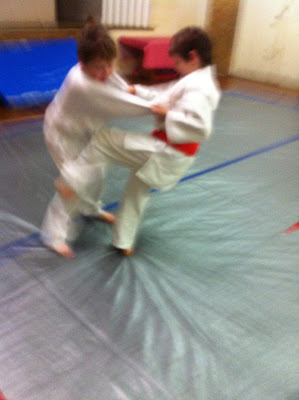
Picture of two kids Judo players, one doing Hiza Guruma

Development Of Kid's Body Through Judo

Ukemi is a physical skill that tempers the body and builds muscle and has significant applications in life. Kids being kids, will insist on coming off bicycles, falling out of trees or just plain falling. By learning how to fall safely (like stuntmen) they may avoid the breaks saving them pain and the expense of taking care of injuries that may now be avoidable with good Ukemi.


    Pent Up Energy

I'm not sure if this is body or mind perhaps both but Judo is right up there with other great sports with ways to provide an outlet for pent-up energy with exercises such as running, stretching, and jumping rope.

kids judo as with all Judo is a continuous test of body and mind.


Wait... More Martial Arts Judo Information Loading


Development Of Kid's Mind Through Judo

Regular training in judo develops the mind as well as the body. Some of the things Judo teaches the mind are:

  • Observation of the situation, people and environment
  • Moving strategically and seizing the initiative
  • Acting decisively by considering the whole picture
  • Knowing when to stop
  • Always be prepared for a contest

These lessons aren’t directly taught but rather naturally infused into training. They decrease the chance of being ‘frozen’ during an unexpected confrontation. An improved mental reaction also leads to an improved physical reaction. A quick assessment of the situation and surroundings and reacting accordingly is especially important.


    Goal Orientated

As children become more skilful in Judo they also become more goal orientated.


    Problem Solving

When introduced to free practice (Randori) and Competition (Shiai – a Japanese word that means to test one's self) your child will enter a semi-uncontrolled setting. They will need to think on their feet and learn to adapt to the situation. The skills that they have lean will inspire self-development and will teach your child to ask questions that will empower them such as ‘how can I avoid this situation and ‘how can I improve in this area.


    Belts And Ranking

Belts and ranking are great ways to help children track their progress and motivate them to strive higher. Belts contribute to your child's confidence and desire to succeed. A system of coloured belts indicates the knowledge and skill levels of the Judoka.

In many cases, the first belt promotion can be attained in a few weeks. When children obtain that first belt, and most everyone not just children loves to have a symbol of their hard work, it shows them that with the right motivation, they can succeed. One belt is never enough, once a child passes one he or she is already thinking about the next one.
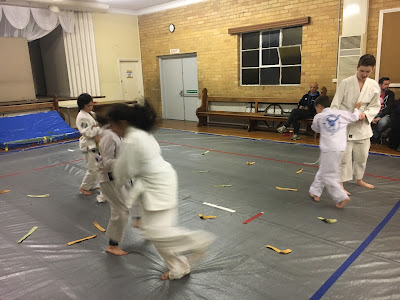
Picture of a Kids Judo game for developing strategy by learning to avoid obstacles at the same time as trying to throw whilst avoiding being thrown by their partner
Development Of Kid's Mind Through Judo


    Emphasis On Individual Achievement

In martial arts, each child’s success is based on his or her own individual qualities. Yes, your child will not always win in their class, but that will be because they tried and lost, not because they were not good enough to make it off the bench. Unlike other sports where they may not even get to play the game, kids Judo is one-on-one so they will always be opportunities for them to play. Knowing that their own ambition and hard work are what will drive them to succeed. They are motivated to follow their dreams without the fear of not having the chance to be a part of the game.


    Increased Concentration Focus and Attention

Whilst no promises can be made children’s concentration has been known to increase exponentially after they start practising kids Judo. This is because they get used to following very detailed and specific instructions from their teachers paired with focusing deeply on their own movements. Many feel like they really want to learn and they’re really engaged, which pushes them to focus more.

If you have ever watched a Judo match you could be forgiven for thinking it is just rough and tumbles. But a Judoka learns problem-solving skills. Everything you learn is a mentally stimulating puzzle. Judo requires a lot of practice and strategy and that puzzle gets more and more complex as you learn more and you face more skilled opponents. Concentration, focus and attention to detail are a natural part of learning Judo.

Perhaps the best part is that these skills are not just limited to judo, but can also extend to other areas of life. For example, studying, taking care of their hygiene, doing chores at home, etc.


Wait... More Martial Arts Judo Information Loading


Development Of Kid's Soul (Character) Through Judo


    Develops Good Character

At its core, Judo if allowed, develops good character. Respect and politeness are built into it and is a guiding principles for all those who study it. It teaches students how to face adversity and potentially how to overcome it.

Other things that are built into training and will become part of the child's character over time, if they are open to it are confidence and self-esteem; self-control and discipline; humility and responsibility as well as thoughtfulness.


    Respect

As a martial art, Judo focuses on building Emotional Health through the three R's Respect for yourself (self-respect), respect towards others, including opponents, and elders and teachers. In tune, this nurtures their trust and confidence so they can grow as balanced and emotionally healthy young adults.

Respect is taught from The First Lesson and is the central lesson of Judo. From the initial bow to avoiding injury of yourself and others, it is a lesson that your child will learn time and time again and that can carry through to all aspects of life.

Judo also instils good sportsmanship. At the beginning and end of a match, both contestants must bow to their opponent as a sign of respect. These acknowledgements signify their willingness to engage for each other’s benefit and to respect winning or losing as learning.


    Confidence And Self-Esteem

The very things that make Judo good for developing the mind are also good for developing self-esteem. The lack the confidence and self-esteem of many kids which inhibits their ability to reach their full potential are diminished as children develop their skills. The more skilful they become the more their confidence increases.

The problem-solving nature of Judo on the mat, its tactical and ever-changing environment requires you to think on your feet. This is one of the best ways to instil confidence and self-esteem in your child. Forcing them to be resourceful, helps them understand that they can overcome challenges regardless of how big or small they might be.

Add to that the feeling of doing a throw well cannot be overstated. You are not restricted to Shiai (full contest) to get that thrill. That feeling is only enhanced when you know that your partner knows how to fall and you are not out to hurt them.


    Self Control And Discipline

Judo is powerful, where skills are practised on another human being. A sport that is unbounded by self-control and discipline, if pushed too far, can result in injury. As your child starts to realise their physical potential and gain strength, and fighting ability, their self-control should improve.

Judo teaches self-control and discipline because it requires a child to focus on mastering the techniques without hurting their partner. This will help also improve their understanding of putting in time and effort in order to gain results. This quickly translates into other real-world activities, especially into studying better at school and learning that the work they put into something will reap the rewards that the work deserves.


    Humility and Responsibility

As we are growing up we’re still searching for our identity. That’s why we test our boundaries more, particularly during our teenage years. Judo allows children and teens to test their boundaries in a controlled environment and doing so helps them learn more about themselves.

You have to learn to respect your training partners and your teachers. You learn that you can't blame others for your shortcomings. You have to take responsibility for what you are responsible for. You learn that if you can't do something, a throw, for example, it's usually your own fault and you have to find out what you are doing wrong and fix yourself not write it off as the problem of someone else.


    Thoughtfulness

The ideal example of this is an incident involving Professor Kano Himself. He wanted to show Judo to the world and in 1889 he went to Europe. Aboard a ship during his voyage, a well-known event occurred when a fellow traveller challenged Professor Kano. The Professor threw the man but put his hand under the man’s head to prevent him from getting hurt. This illustrates that, from inception, Judo is intended to consider the welfare of even our opponents.


    Mitigate The Consequences Of That Fall

Whilst Ukemi is a physical skill that tempers the body and builds muscle, it also develops the sole because it teaches you that you can fall and mitigate the consequences of that fall.


Wait... More Martial Arts Judo Information Loading


Judo Is More Than Just a Martial Art or Sport, It Is Education For Life

When you learn Judo you learn more than just throwing and grappling and self-defence, you learn life skills. Beginning with a bow as a sign of respect, the lessons continue, learning how to coordinate and balance your life as well as your body, and mind. And possibly the most important thing is that when things or life in general throw you, you can fall and get back up and mitigate injury in the process.

As well as mastering the art of Judo, participants also learn the art of Randori, which is seen as a form of physical chess. Participants soon realise that they are more capable than they first thought, testing their minds and bodies against their opponents.

Just as in life, participants will be thrown, pinned down and challenged, pushing them to learn and study from their mistakes. Judo is a sport that challenges the mind and body to work as one!

When you learn Judo, you don’t just learn how to defend yourself better, you learn to control and trust your body as well. And the benefits of Judo, like most martial arts, are both physical and mental.


Popular Posts